Zero Trust Architecture Explained: The What, Why, and How for Network Architects
A practical, no-hype breakdown of the framework replacing perimeter security — and a phased path to get there.
Most enterprise networks were designed around a simple assumption: once you're inside the perimeter, you're trusted. That assumption made sense when "inside" meant a physical office, a corporate VPN, and a handful of on-prem servers. It makes almost no sense today, when your workforce, your applications, and often your data no longer live behind any single perimeter at all. Zero Trust architecture (ZTA) is the industry's answer to that shift — not a product you buy, but a set of principles that assume every request, from every user and every device, is potentially hostile until proven otherwise. This guide walks through what Zero Trust actually is, why it has moved from "nice to have" to board-level priority, and how architects can implement it in phases without grinding the business to a halt.
What Is Zero Trust Architecture?
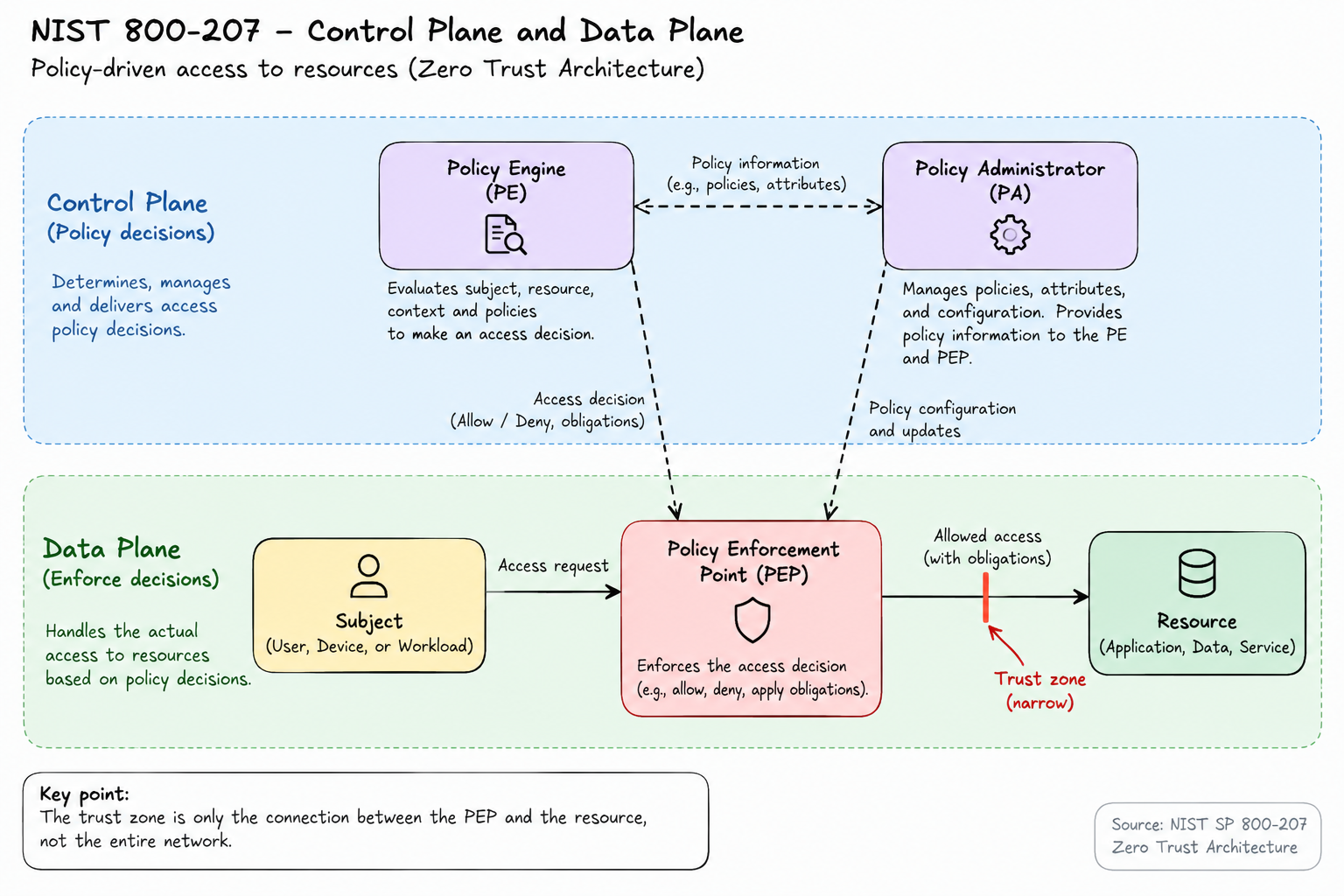
Zero Trust is formally defined by the U.S. National Institute of Standards and Technology in NIST Special Publication 800-207, the closest thing the industry has to a common reference point. NIST describes it as a collection of concepts designed to minimize uncertainty in enforcing accurate, least-privilege, per-request access decisions — on the assumption that the network is already compromised. In plain language: nothing gets implicit trust because of where it sits on the network. Every subject (a user, a service account, a workload) must be authenticated and authorized before it reaches any resource, every single time.
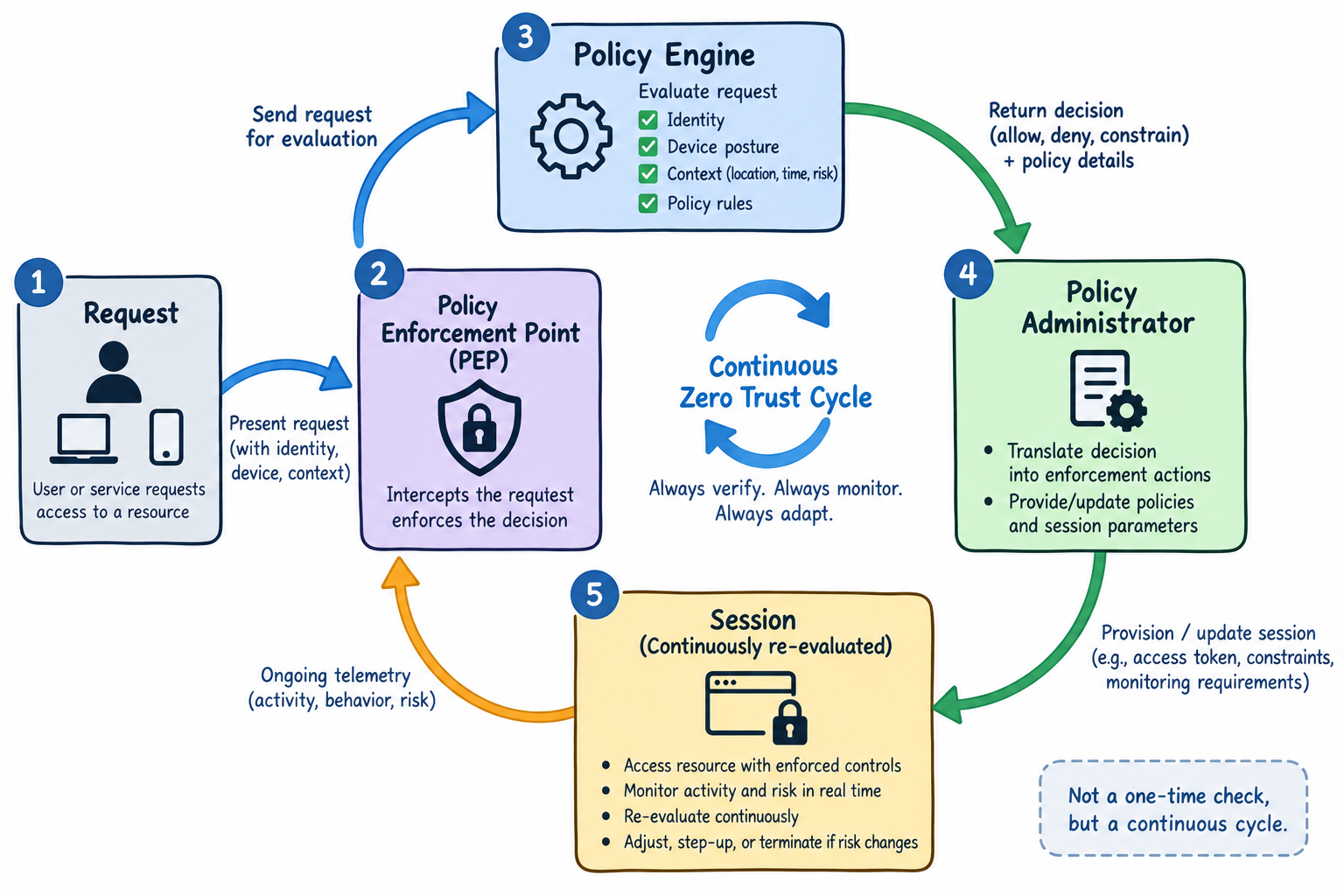
Architecturally, NIST breaks this down into three interacting components: the Policy Engine, which decides whether to grant, deny, or revoke access based on identity, device posture, and context; the Policy Administrator, which executes that decision by establishing or tearing down the session; and the Policy Enforcement Point (PEP), which sits directly in front of the resource and is the only thing a subject actually talks to. There is no broad, flat network to move laterally across — only narrow, individually authorized paths to specific resources.
The Seven Tenets of Zero Trust
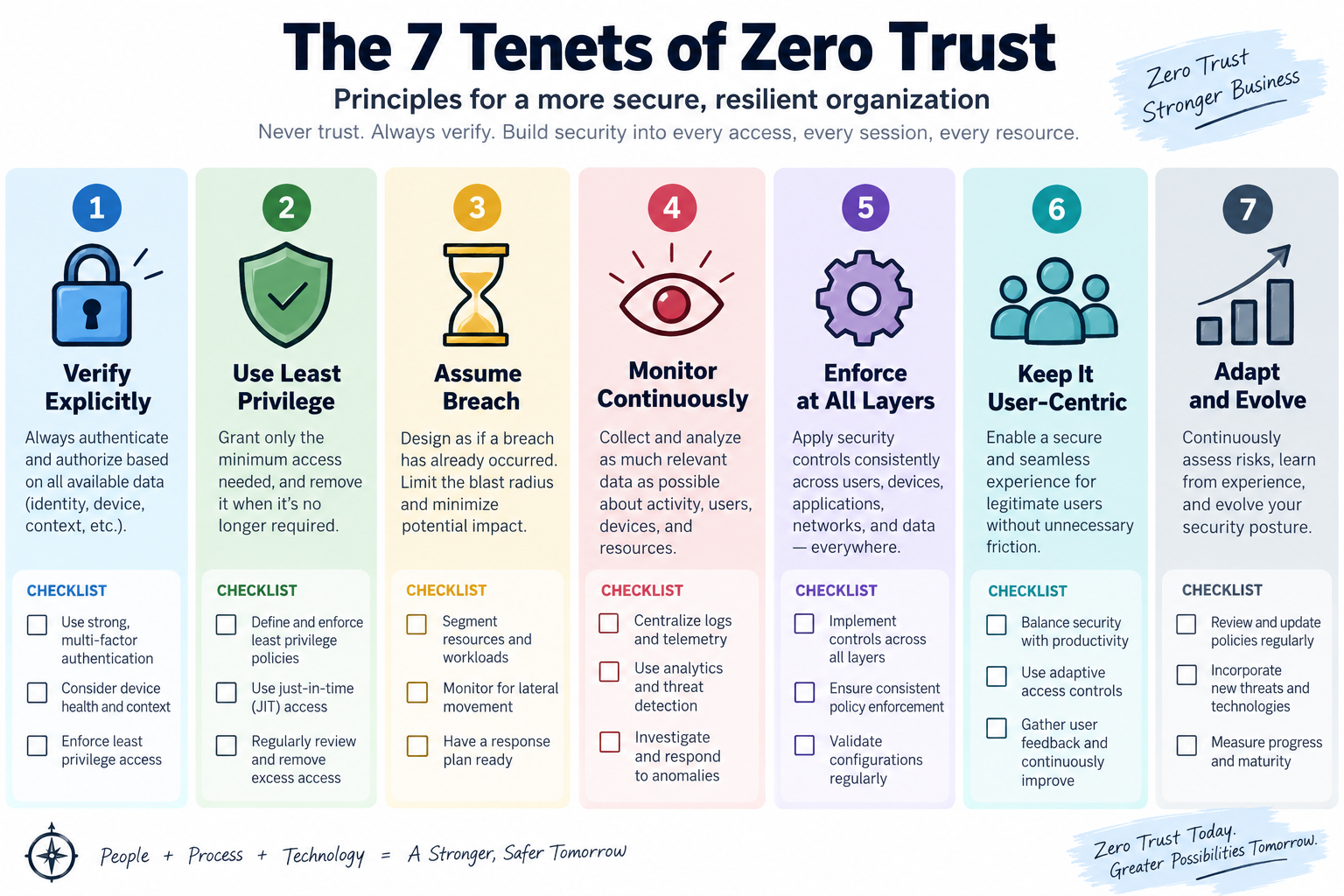
NIST 800-207 lays out seven tenets that, taken together, define what a Zero Trust architecture actually requires in practice. They are worth pinning to the wall of any architecture review:
- All data sources and computing services are treated as resources — including SaaS apps, APIs, and even personal devices that touch enterprise data.
- All communication is secured regardless of network location — internal traffic gets encrypted and verified exactly like traffic from the public internet.
- Access to individual resources is granted per-session — trust is evaluated at the point of the request, not once at login for the whole day.
- Access is determined by dynamic policy — incorporating identity, device health, workload state, and behavioral signals, not just a static role.
- The enterprise monitors and measures the integrity of all owned and associated assets — nothing is assumed to be clean by default.
- All resource authentication and authorization is dynamic and strictly enforced before access is allowed — a continuous cycle of scan, assess, adapt.
- The enterprise collects as much information as possible on the current state of assets, network infrastructure, and communications — and uses it to continuously improve policy.
Why Zero Trust Matters Now: The Perimeter Has Dissolved
Perimeter security was never actually about the perimeter — it was about controlling where trust lived. That control has quietly evaporated over the last decade. Workforces are hybrid. Applications live across multiple clouds. Contractors, partners, and third-party APIs routinely need access to internal systems. And attackers have adapted accordingly: the fastest-growing attack pattern isn't breaching the wall, it's walking through the front door with stolen credentials and then moving laterally, unchallenged, because everything "inside" was trusted by default.
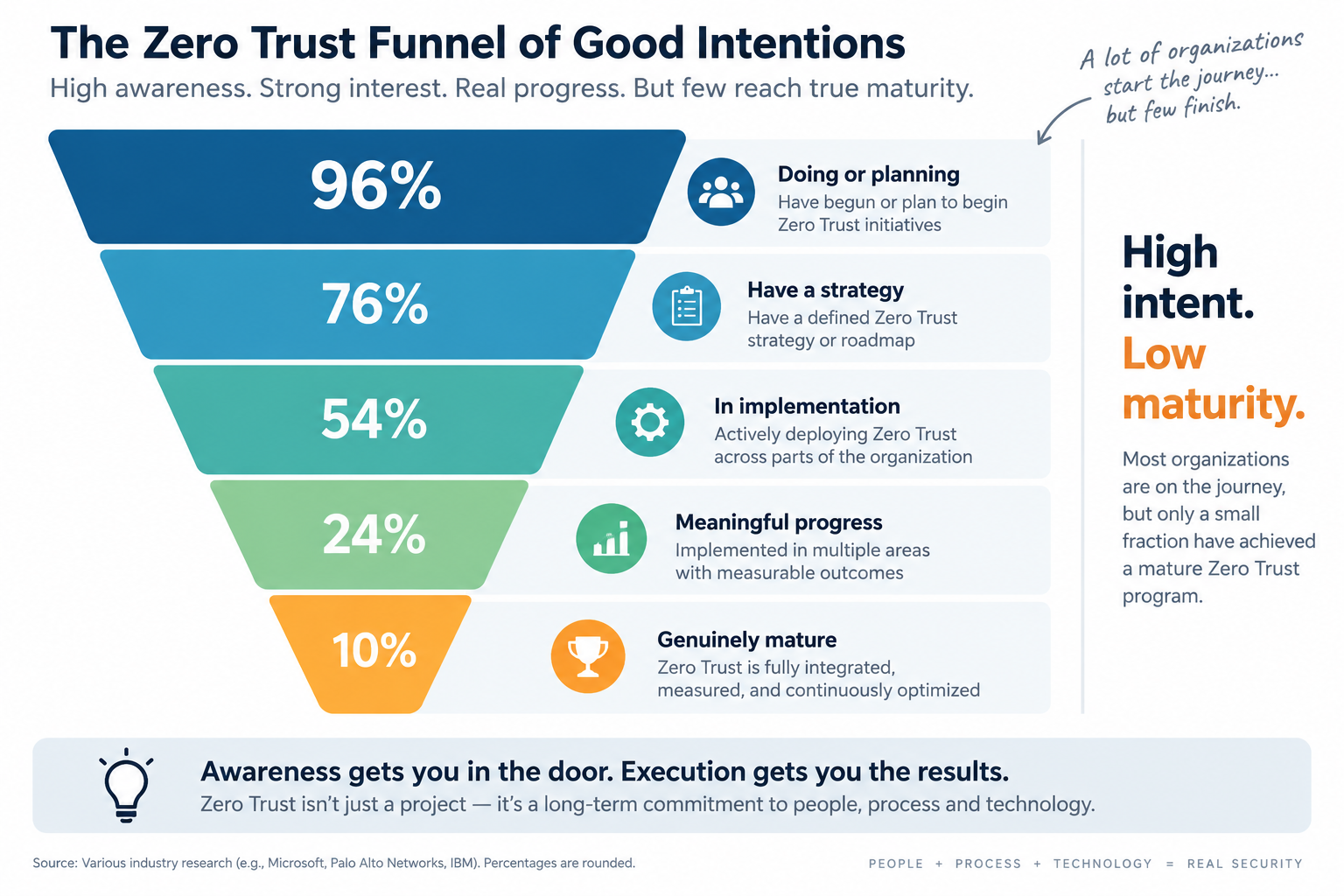
The numbers back this up. According to Okta's State of Zero Trust Security research, 61% of organizations worldwide say they have already launched a Zero Trust initiative, nearly triple the 24% figure from just a few years earlier — and another 35% say they plan to start soon. Adoption intent is nearly universal. But intent and maturity are two very different things.
Zero Trust vs. Perimeter-Based Security: A Side-by-Side
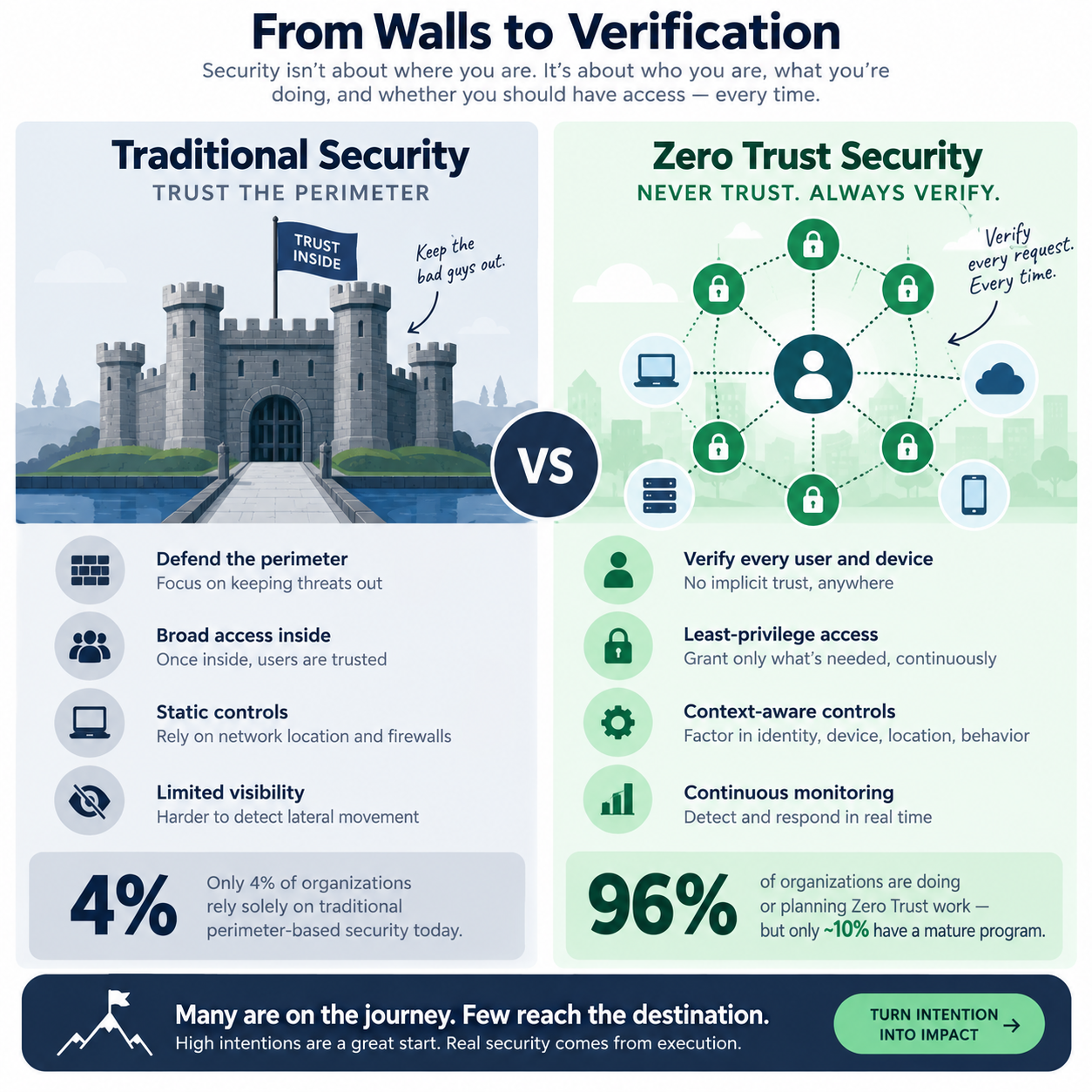
For architects evaluating where to invest first, it helps to see the two models laid out directly against each other. The differences aren't cosmetic — they change how you design network segmentation, identity systems, and monitoring from the ground up.
| Dimension | Perimeter-Based Security | Zero Trust Architecture |
|---|---|---|
| Trust boundary | Network edge (firewall, VPN) | Individual session, per resource |
| Internal traffic | Implicitly trusted | Authenticated and encrypted like external traffic |
| Access control | Static roles, broad network access | Dynamic, contextual, least-privilege |
| Lateral movement | Easy once inside the perimeter | Constrained by microsegmentation |
| Remote/cloud fit | Poor — requires backhauling through VPN | Native — identity travels with the user |
| Breach assumption | Perimeter will hold | Network is already compromised |
The Business Case: Quantifying the ROI
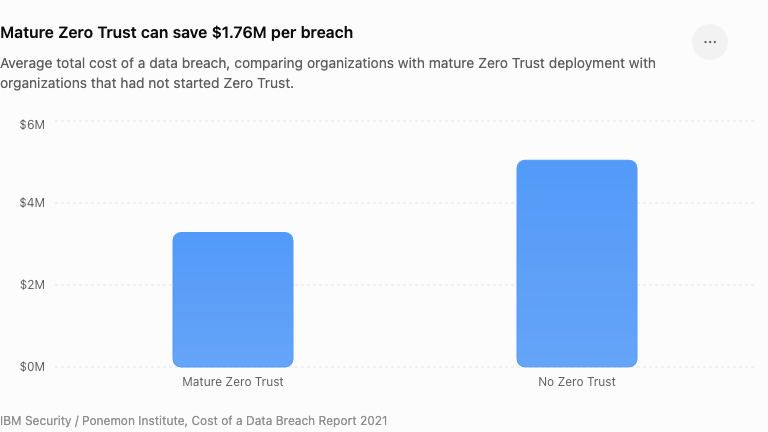
Security architects rarely get budget purely on principle — they get it when the financial case is unambiguous. Zero Trust has one. Organizations with a Zero Trust architecture in place reduced the average cost of a breach by roughly $1.76 million per incident compared to organizations without one, according to recent industry breach-cost research. Separately, 63% of organizations cite risk reduction and breach-impact limitation as their primary motivation for pursuing Zero Trust in the first place — ahead of compliance or cost savings.
The market is voting with its wallet too: the global Zero Trust architecture market was valued at roughly $31.8 billion in 2026 and is projected to grow at an 18% compound annual rate through the early 2030s, with the Zero Trust Network Access (ZTNA) segment growing even faster as it displaces legacy VPNs as the default remote-access pattern.
The Zero Trust Reference Architecture: How the Pieces Fit
It's worth resisting the temptation to treat Zero Trust as a shopping list of products. The reference architecture is really a decision loop repeated for every access request. A subject requests access to a resource. That request hits a Policy Enforcement Point, which has no decision-making authority of its own — it simply asks the Policy Engine, in the control plane, whether this specific request should be allowed right now. The Policy Engine evaluates identity assurance, device health, behavioral risk signals, and the sensitivity of the resource, then instructs the Policy Administrator to open, deny, or terminate the session. Crucially, this evaluation doesn't happen once at login — it recurs continuously, so a session can be revoked mid-stream if risk signals change.
This loop is what allows Zero Trust to scale beyond a single network. Identity — not IP address or network segment — becomes the true perimeter, which is exactly why identity and access management occupies the largest single share of Zero Trust technology spend today.
A Phased Roadmap for Implementation
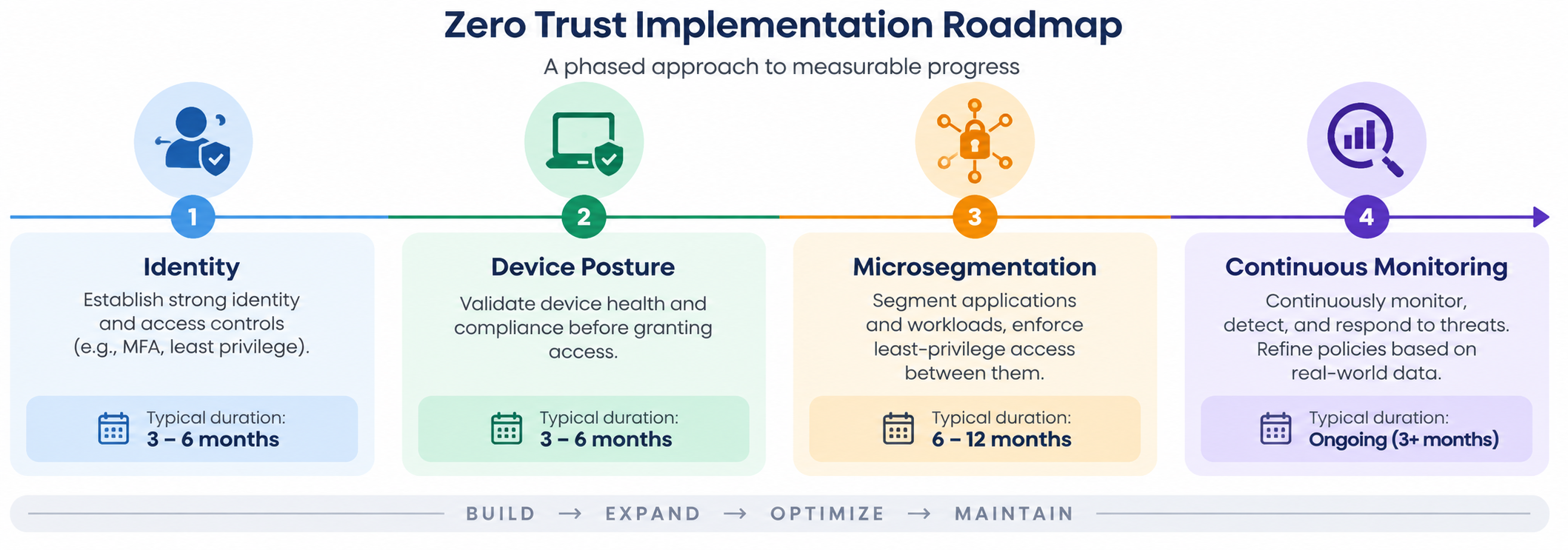
Because Zero Trust touches identity, networking, endpoint, and application layers simultaneously, architects who try to implement it all at once tend to stall. A phased approach — one that delivers visible wins early — holds up far better against organizational fatigue and budget scrutiny.
Phase 1: Identity as the Foundation
Start by consolidating identity providers, enforcing multi-factor authentication everywhere (including service accounts and machine identities), and moving toward single sign-on across critical applications. Nothing downstream works without this layer being solid.
Phase 2: Device and Workload Posture
Extend verification beyond "who" to "what." Enforce device health checks — patch level, disk encryption, endpoint protection status — before granting access, and start treating workloads and service accounts with the same rigor as human identities.
Phase 3: Microsegmentation and Least-Privilege Networking
Replace flat internal networks with granular segments, so that compromising one workload doesn't grant a path to everything else. This is typically the most operationally disruptive phase, and the one where architects should expect the most pushback from application teams.
Phase 4: Continuous Monitoring and Adaptive Policy
Feed telemetry from identity, network, and endpoint layers into a policy engine capable of adjusting access dynamically — tightening controls automatically when risk signals spike, without waiting for a human to intervene.
Core Technology Building Blocks
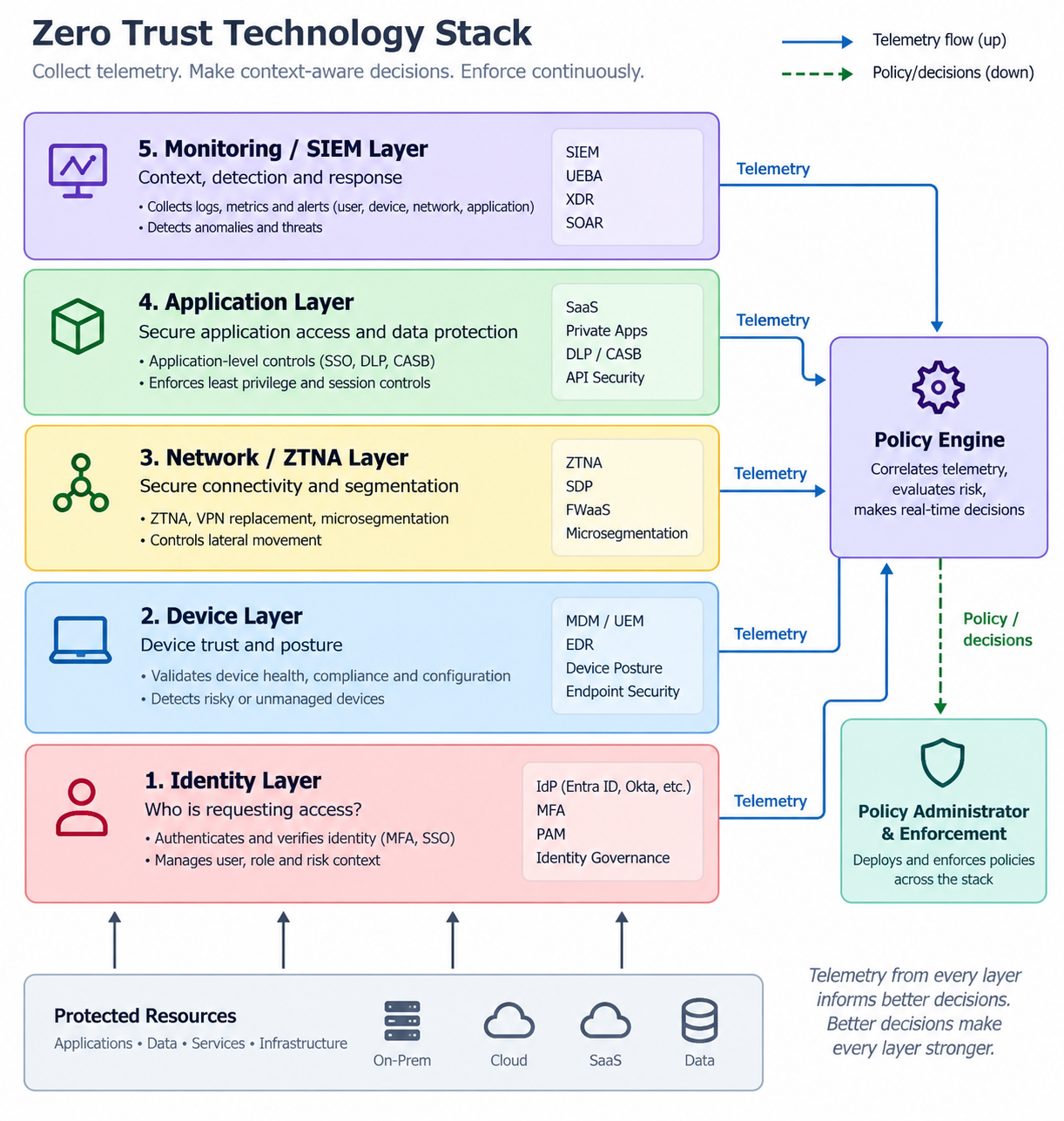
No single vendor delivers a complete Zero Trust architecture, which is itself a common source of the "tool sprawl" problem discussed below. The core building blocks architects typically need to assemble include: an identity provider with strong MFA and conditional access policies; a Zero Trust Network Access (ZTNA) layer to replace traditional VPN for remote and third-party access; microsegmentation tooling for east-west traffic control; endpoint detection and response (EDR) for device posture signals; and a security information and event management (SIEM) or extended detection and response (XDR) platform to unify telemetry and feed the policy engine.
Cloud-based deployment now accounts for the majority of new Zero Trust implementations, largely because it lets architects apply consistent policy across SaaS, IaaS, and on-prem resources from a single control plane, rather than maintaining separate policy logic for each environment.
Avoiding the Execution Gap: Common Pitfalls
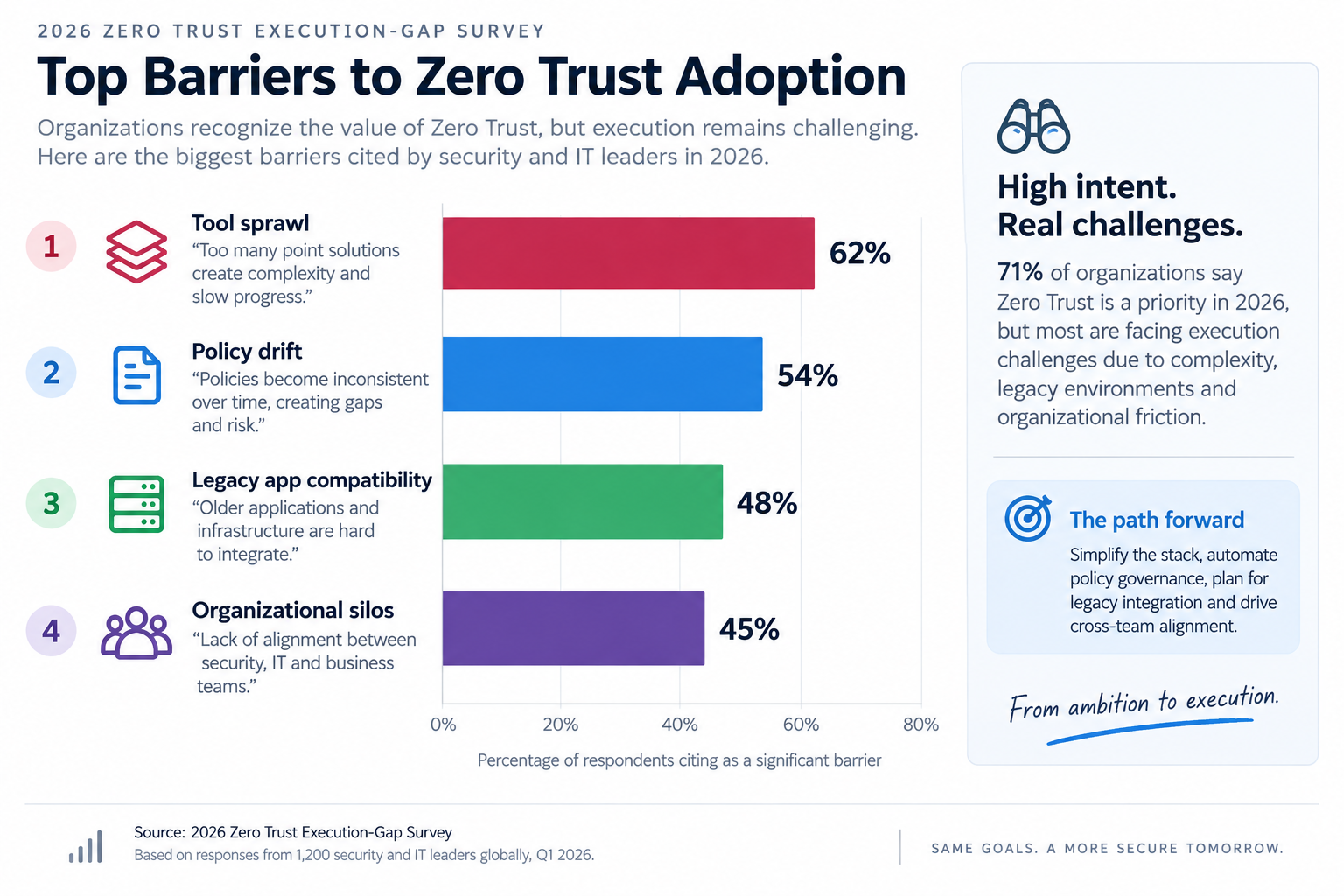
Most Zero Trust programs don't fail because the principles are wrong — they stall because of how they're executed. The most commonly cited barrier, reported by roughly a quarter of organizations, is tool and vendor sprawl: too many overlapping point solutions, each with its own policy language, none of them talking to each other. A related 2026 industry survey found that 82% of organizations view Zero Trust network access as essential, yet only 17% have fully implemented it — and the same respondents rated their current Zero Trust effectiveness at just 6 out of 10, citing architectural fragmentation and policy drift across hybrid environments as the core obstacles.
The practical lesson for architects: consolidate onto a smaller number of platforms with genuine policy interoperability before adding new point solutions, and resist the instinct to buy your way out of an architecture problem.
Zero Trust and Regulatory Compliance
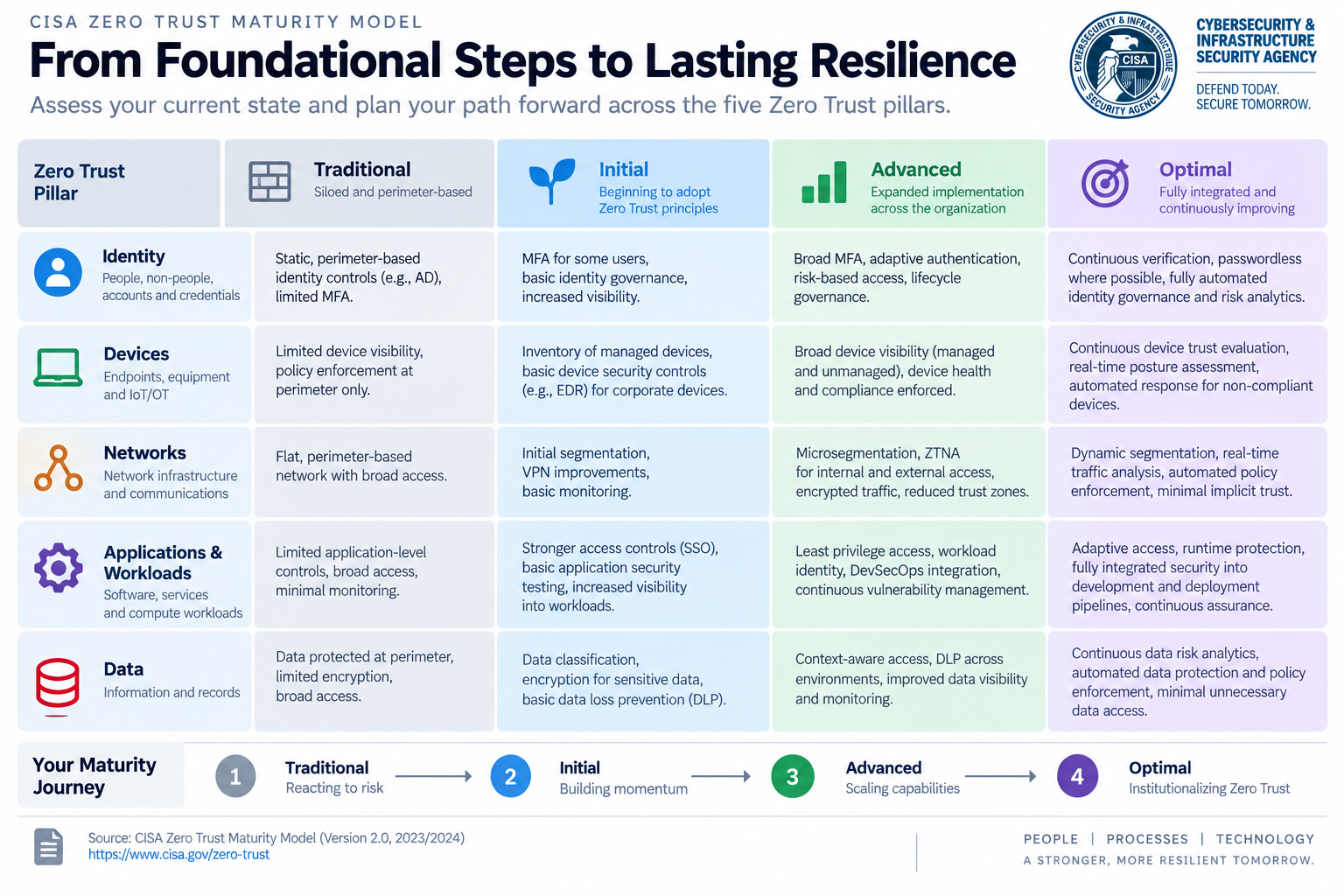
For architects in regulated industries, Zero Trust isn't purely a technical preference — it's increasingly a compliance requirement. U.S. federal agencies have been mandated to move toward Zero Trust architectures under a series of executive directives, and CISA's Zero Trust Maturity Model has become a de facto benchmark used well beyond government, giving architects in any sector a structured way to score their program across identity, devices, networks, applications, and data pillars. Analysts have also noted that a majority of federal agencies are likely to fall short of full implementation on their original timelines, underscoring just how demanding a genuinely mature program is to execute, even with mandated budget and political priority behind it.
Measuring Success: KPIs Architects Should Track
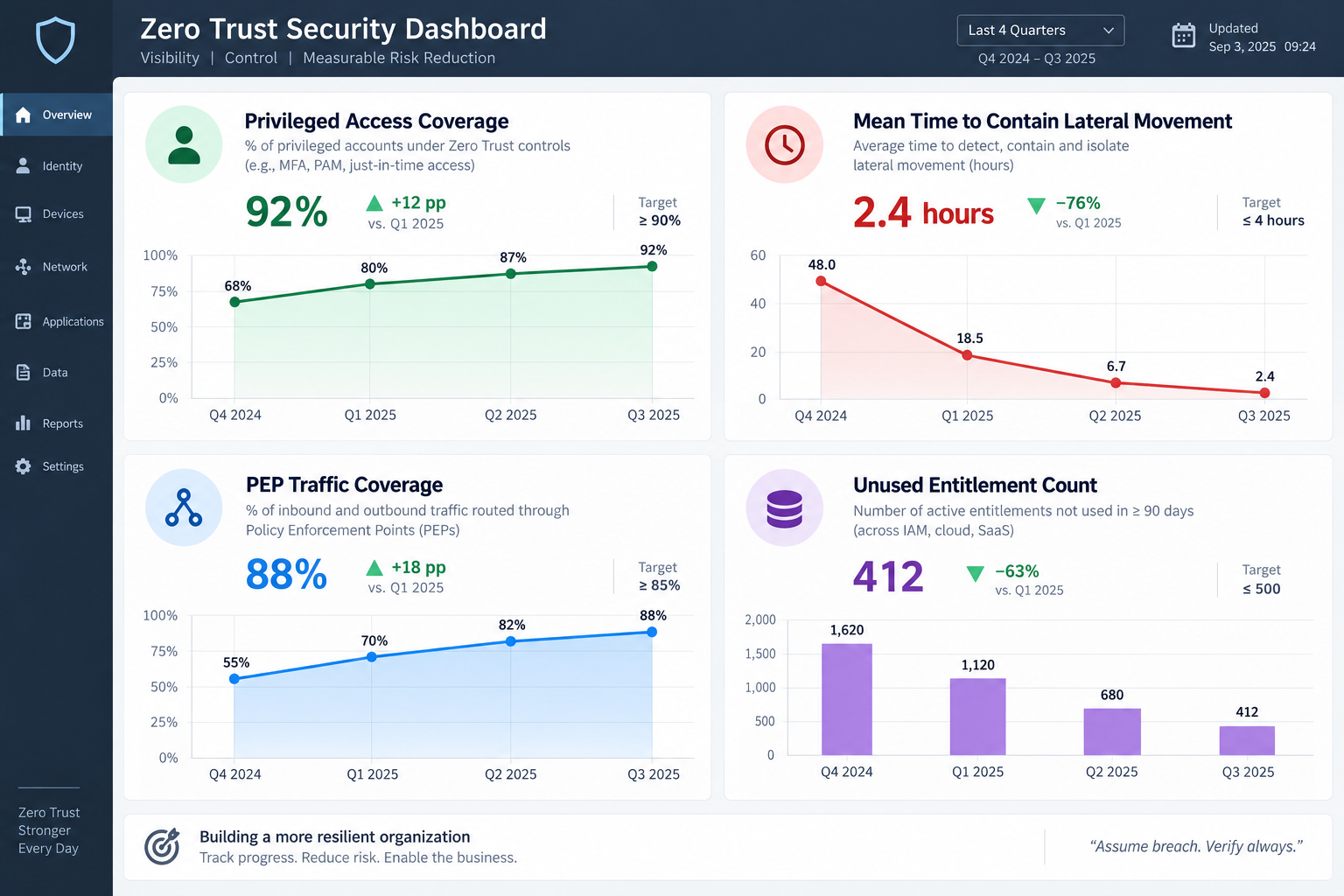
Zero Trust programs are easy to start and hard to prove out, so it's worth defining metrics before the first phase kicks off rather than after. Useful leading indicators include: percentage of privileged access enforced via just-in-time, time-bound grants rather than standing access; mean time to detect and contain lateral movement; percentage of east-west traffic passing through a policy enforcement point rather than an open flat network; and reduction in the number of standing, unused access entitlements identified during periodic access reviews. These metrics tend to matter more to executive stakeholders than architecture diagrams, because they translate directly into risk reduction they can see quarter over quarter.
For architects who want a deeper technical grounding beyond this post, NIST's own SP 800-207 publication remains the primary source document, and CISA's Zero Trust Maturity Model page is the most useful practical companion for benchmarking an existing program. A well-produced explainer video search — such as IBM Technology's "What is Zero Trust?" series on YouTube — is also a solid way to bring non-technical stakeholders up to speed before a budget conversation.
Conclusion
Zero Trust architecture replaces a single assumption — "inside the perimeter means trusted" — with a discipline of continuous, per-request verification grounded in identity, device health, and context. NIST SP 800-207 provides the reference model: subjects, resources, and a Policy Enforcement Point mediated by a Policy Engine and Policy Administrator, all built around seven core tenets. The case for adopting it is no longer theoretical — perimeter security has effectively dissolved under hybrid work and cloud adoption, breach costs are measurably lower for organizations with mature Zero Trust programs, and the market is growing at nearly 18% annually. Yet adoption intent (over 90%) and true maturity (roughly 10%) remain far apart, mostly due to tool sprawl and fragmented execution rather than flawed principles. The path forward for architects is a phased one: identity first, then device posture, then microsegmentation, then continuous adaptive monitoring — each phase measured against concrete KPIs rather than checkbox compliance. Done well, Zero Trust isn't a single project with an end date; it's an operating model that keeps recalibrating trust as the organization, its workforce, and its threat landscape keep changing.
Bring the same discipline to how your firm tracks its time.
If you're an architect at a law firm, accounting practice, or professional services organization securing sensitive client data with Zero Trust principles, it's worth applying the same rigor to how billable time is captured and reported. Chrometa passively tracks time in the background so nothing falls through the cracks — no manual entry, no guesswork, no gaps in the record. See how Chrometa fits into a security-conscious professional services stack →
Similar Stories


Enterprise
5 Resources to Boost Your Freelance Productivity
The modern freelancer has a lot of plates to spin on a daily basis in order to succeed – and there never seems to be enough hours in the day. Those that use their limited time most efficiently will blow past the competition and make an impact in their chosen market. . Read More

Enterprise
6 Tips to Maintain a Healthy Work-Life Balance during COVID
Confinement, lockdown, quarantine, shelter-in-place… .... Read More