Shadow AI in Law Firms: Why Visibility, Governance, and Auditability Matter More Than AI Features
The biggest risk isn't the AI your firm chose. It's the AI your firm doesn't know about.
Artificial intelligence is arriving in law firms faster than most governance programs can keep up. While firms evaluate enterprise AI platforms and draft acceptable-use policies, attorneys and staff are already experimenting with ChatGPT, Copilot, Claude, Gemini, Perplexity, and dozens of other AI-powered tools on their own initiative.

This phenomenon—commonly called Shadow AI—is rapidly becoming one of the most consequential technology governance challenges facing legal organizations. And unlike past technology waves, this one involves tools that actively process and reason over client information, legal research, and privileged communications.
The question is no longer whether AI is being used in your firm. The question is whether your firm understands how it is being used, by whom, on what data, and with what accountability trail.
What Is Shadow AI?
Shadow AI refers to the use of artificial intelligence tools—chatbots, writing assistants, summarization engines, code generators—that operate outside of a firm's formal technology approval, procurement, or oversight processes.
It follows the same pattern as the Shadow IT wave that blindsided legal and professional services firms during the cloud and SaaS adoption era, when Dropbox, Google Docs, and personal email accounts quietly replaced sanctioned file storage and communication channels. The difference is that Shadow IT largely moved where information was stored. Shadow AI changes what happens to that information—it gets analyzed, summarized, rephrased, and fed into systems operated by third parties.
Common Shadow AI behaviors already appearing in law firms include:
- Uploading contracts or settlement agreements into public-facing AI tools for summarization
- Using consumer AI services to draft client communications and engagement letters
- Generating legal research summaries with tools that retain user inputs for model training
- Running depositions, discovery documents, or case notes through AI assistants without IT review
- Connecting personal AI subscriptions to firm systems—calendars, email, document management—without authorization
Each of these behaviors may feel harmless in isolation. Cumulatively, they represent a significant and largely invisible exposure surface.

Why Law Firms Are Particularly Vulnerable
Every professional services organization faces Shadow AI challenges. Law firms face them at higher stakes. Three characteristics make the legal environment uniquely high-risk.
The Confidentiality Surface Is Enormous
Attorney-client privilege, work product doctrine, and professional responsibility rules create a broad and legally enforceable confidentiality perimeter around almost everything a law firm touches. Unlike a marketing agency or a logistics company, nearly every document a firm produces—client communications, litigation strategy, due diligence analysis, deal structures—is presumptively confidential.
When an attorney pastes a contract excerpt into ChatGPT to speed up redlining, or runs opposing counsel's filing through a summarization tool, there is a non-trivial risk of exposing privileged information to a system operating under terms of service that were never reviewed by the firm's general counsel.
The Intellectual Property at Risk Is Irreplaceable
Beyond individual client matters, law firms hold enormous concentrations of institutional knowledge: annotated precedent libraries, deal templates refined over decades, proprietary research methodologies, and internal playbooks for how the firm approaches specific practice areas. This is the intellectual infrastructure that differentiates a firm in competitive markets.
AI tools that ingest this content—especially consumer-grade tools with permissive data retention policies—can effectively drain that institutional knowledge into third-party infrastructure without a single line item appearing in any security or compliance log.
Regulatory and Ethical Obligations Have No Tolerance for "We Didn't Know"
Bar association guidance on technology competence, client confidentiality obligations under Rules 1.6 and 1.9 of the Model Rules of Professional Conduct, and emerging data protection frameworks (including GDPR where applicable) all impose obligations that are difficult to satisfy without basic visibility into which AI systems are touching client data.
"We didn't know attorneys were using that tool" is not a defense recognized by professional responsibility boards. Firms are increasingly expected to demonstrate affirmative oversight, not passive ignorance.

The Real Risk Isn't AI—It's the Absence of Visibility
The instinctive response from many legal IT leaders is to block AI tools. Block ChatGPT at the firewall. Restrict browser extensions. Build an approved list and prohibit everything else.
Blocking is not a governance strategy. It is a temporary friction measure that delays adoption without addressing the underlying dynamic. The attorneys most likely to work around AI restrictions are often the firm's most productive—the partners billing the most hours who are most motivated to find productivity leverage.
The more durable challenge is not stopping AI use; it is understanding it. Before a firm can govern AI, it needs answers to foundational questions:
- How many distinct AI tools are currently in active use across the firm?
- Which practice groups and departments have the highest AI adoption rates?
- Are approved tools actually being used, or have attorneys defaulted to consumer alternatives?
- Which workflows—time entry, research, drafting, billing review—have AI components embedded in them?
- What data sources are AI tools drawing from or submitting to?
Without this visibility, governance becomes guesswork. Policies issued without usage data are not compliance frameworks—they are aspirational documents.
Research Context — ICWE 2026
Researchers at the 26th International Conference on Web Engineering (ICWE 2026) reached a structurally identical conclusion in the enterprise software context: "Users who interact with third-party-operated systems first need to filter any data that is to be sent to the AI agent to avoid unintentionally exposing any sensitive information." When users must self-police what they share with AI tools, governance has already broken down. The answer is architectural, not behavioral.
— Schröder & Gaedke, Towards Governance-Aware Local and Hybrid AI Agents for Web Applications, ICWE 2026
The Four Pillars of Responsible AI Governance in Legal Organizations
Building a sustainable legal AI governance program requires four interconnected capabilities. Think of them as load-bearing walls—the absence of any one destabilizes the entire structure.
Pillar 01 - Visibility
You cannot govern what you cannot see. Visibility means real-time awareness of which AI tools are in use, in which workflows, and by whom. It turns governance from a policy exercise into an empirical one.
Pillar 02 - Governance
Governance is not about preventing innovation—it is about creating safe boundaries within which innovation can happen. Approved vendor lists, acceptable-use policies, and regular policy reviews are the skeleton of a governance program.
Pillar 03 - Access Control
Not all information should be accessible to every AI system. Matter-level restrictions, HR data, financial records, and client-confidential documents require enforced permissions, not honor systems.
Pillar 04 - Auditability
Six months after an AI-assisted work product is delivered, can your firm reconstruct which model was used, what information was provided, who reviewed the output, and what action was taken? If not, you have an auditability gap.
Let's go deeper on each.
Pillar 1: Visibility — You Cannot Govern What You Cannot See
Visibility in the AI governance context is not just about knowing which software is installed. It is about understanding how AI fits into the actual workflows that drive firm revenue—time recording, document drafting, client intake, research, billing review, and matter management.
The firms best positioned to govern AI are the firms that already understand how work happens across their technology ecosystem. That understanding does not come from periodic surveys or self-reporting. It comes from systematic, persistent visibility into software usage and work activity patterns.
Chrometa's automatic time tracking sits at the intersection of both. By capturing how attorneys and staff actually spend time across applications—not how they remember spending time when they fill in a timesheet—Chrometa surfaces the behavioral data needed to understand which AI tools are embedded in daily workflows, and at what scale.
Questions that visibility enables:
- What applications are attorneys spending the most time in, and have those patterns shifted?
- Where does AI fit into the highest-billing workflows?
- Which business processes have been quietly transformed by individual AI adoption?
- Are there workflows that should be AI-assisted but aren't, because approved tools are underused?
Pillar 2: Governance — Safe Boundaries Enable Innovation
A governance framework that only says "no" will fail. Attorneys adopt AI tools because those tools make them faster and more effective. A governance program that ignores that reality will be worked around, not followed.
Effective AI governance in law firms requires:
- An approved AI vendor list, maintained by IT and updated at least quarterly
- Acceptable-use policies that specify which use cases are permitted with which tools
- Data classification requirements that define how AI tools may interact with different information categories (public, internal, confidential, privileged)
- Vendor security reviews for any AI tool that touches client data
- Clear ownership: who in the firm has final authority over AI tool approvals?
The Cloud Analogy
When firms first encountered cloud storage in the early 2010s, many tried to block it entirely. Attorneys used personal Dropbox accounts anyway. The firms that came out ahead were those that quickly adopted governed cloud infrastructure—SharePoint, NetDocuments, iManage—that gave attorneys the convenience they were seeking within a controlled environment. The same dynamic is now playing out with AI. The choice is not "AI or no AI." It is "governed AI or ungoverned AI."
Pillar 3: Access Control — Not Every AI System Should See Everything
One of the most important and underappreciated dimensions of legal AI governance is fine-grained access control: defining precisely which AI systems can access which information, and enforcing those boundaries technically rather than through policy alone.
This is harder than it sounds. Most law firm data environments were not designed with AI access patterns in mind. Matter management systems, document repositories, email archives, and billing platforms were built for human users authenticated by role. AI systems can aggregate across all of these in ways that were never anticipated by the original access control design.
A research team at ICWE 2026 introduced SBAC (Shape-Based Access Control), a novel access control framework for knowledge graphs that operates at the schema level—meaning permissions are defined by data structure and shape, not just role. The core insight translates directly to legal AI: fine-grained access control that scales must be declarative and schema-driven, not maintained as an ever-growing list of individual rules. As AI systems query and aggregate across knowledge bases, traditional role-based access control (RBAC) alone is insufficient—it wasn't designed for the access patterns AI introduces.
— SBAC: A Shape-Based Access Control Model for Knowledge Graphs, ICWE 2026
Practical access control for legal AI environments requires answers to questions most firms haven't yet asked:
- What categories of firm data are AI systems currently able to access?
- Does matter-level confidentiality extend to AI query surfaces, or only to human interfaces?
- Are there data categories—HR records, financial data, under-seal litigation files—that have been explicitly excluded from AI access?
- How are those permissions enforced, and by what mechanism are they audited?
The goal is not to restrict AI so aggressively that it can't be useful. The goal is to ensure that the information an AI system can access and reason over is the information that your governance program has deliberately authorized—not the information that happened to be reachable by default.
Pillar 4: Auditability — The Accountability Trail That Regulators Will Demand
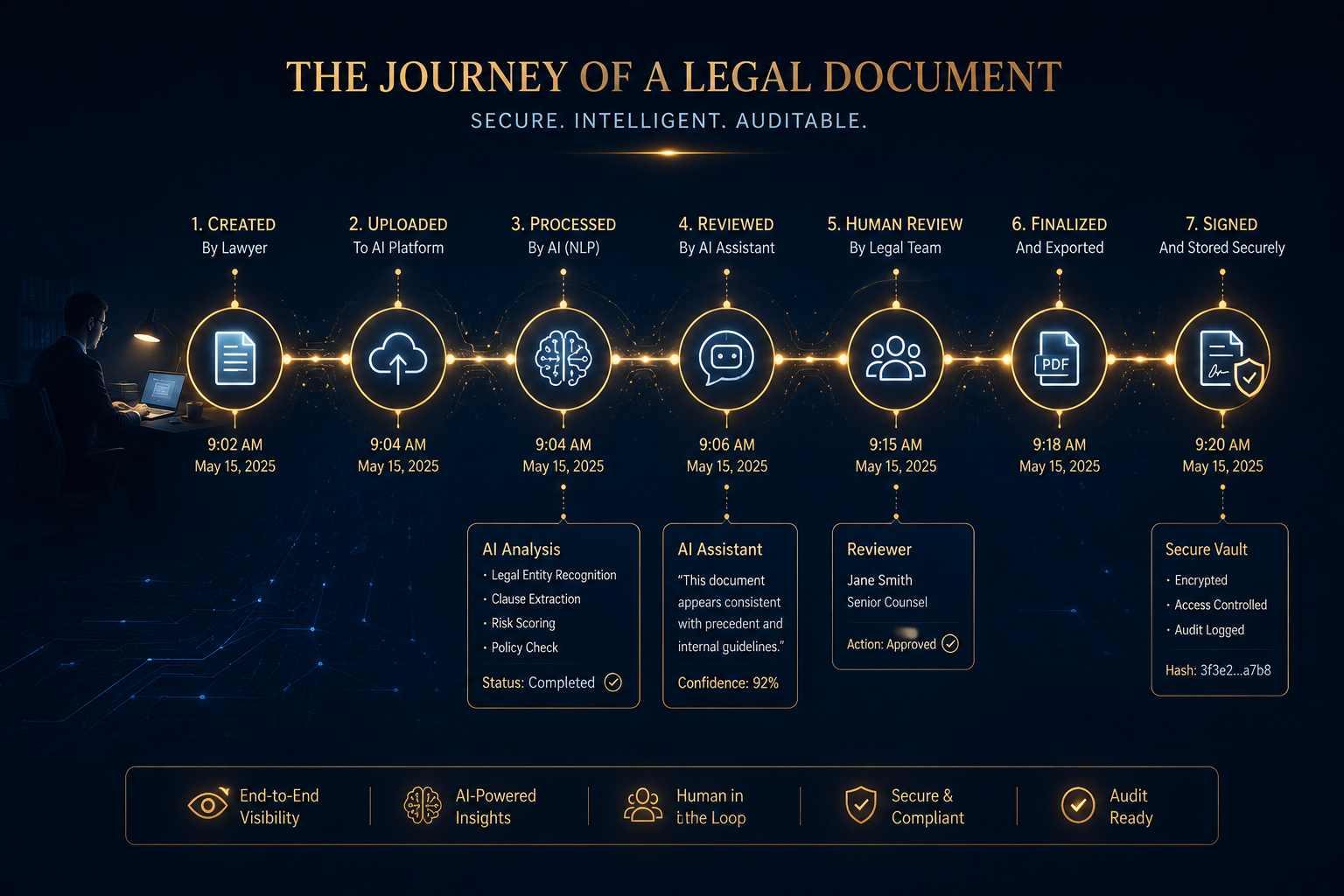
Auditability may be the most forward-looking of the four pillars, and also the most underdeveloped in current legal AI implementations.
The question is simple: six months from now, if a client, a regulator, or a bar association asks about an AI-assisted work product, can your firm reconstruct:
- Which AI system or model was used, and what version?
- What information was provided to that system as context?
- What output was generated, and what exactly was delivered to the client?
- Who reviewed the AI output before it was used?
- What action was taken based on that output, and when?
For most firms using consumer or lightly governed AI tools today, the answer to most of these questions is: no. That may be acceptable for low-stakes internal use. It is not acceptable for client-facing work product, litigation strategy, or any output that could later be scrutinized.
Researchers from Université Paris Dauphine-PSL presented MLProvLens at ICWE 2026, an interactive system for exploring end-to-end provenance in machine learning pipelines aligned with the W3C PROV standard. The system's core contribution—distinguishing between prospective lineage (what the pipeline was designed to do) and retrospective lineage (what it actually did)—maps precisely to the legal auditability problem: what was the AI tool supposed to do, and what did it actually do with the client's data? Full traceability from raw input to final output is not a research aspiration; it is an engineering requirement for responsible deployment.
— Alban, Belhajjame & Grigori, MLProvLens: Exploring End-to-End Provenance in ML Pipelines with a W3C PROV-Aligned Framework, ICWE 2026
Enterprise AI platforms designed for regulated industries are beginning to build audit logs into their architectures. But many firms are deploying AI tools—or allowing their attorneys to deploy AI tools—that were built for consumer use cases where audit trails are an afterthought.
Auditability is not a feature you can retrofit. It needs to be a selection criterion when evaluating and approving AI tools for legal use.
The Privacy Dimension: Why Data Minimization Matters for Legal AI
Beyond the four governance pillars, there is a structural question about how legal AI should be architected: how much client data should AI systems actually need to access?
The instinct of most enterprise AI deployments is to give AI systems broad data access, on the theory that more context produces better outputs. That instinct needs to be challenged in the legal environment, where the principle of minimum necessary disclosure is already deeply embedded in professional responsibility rules.
A 2026 ICWE paper on privacy-aware local-first user modeling demonstrated that accurate and stable behavioral models can be constructed from strictly minimized, locally processed data—without centralizing raw information. The key principle: usage events captured with strict data minimization, stored and processed on-device, transformed into behavioral representations without centralizing raw traces. Applied to legal AI: firms should demand that AI systems work from minimized, purpose-limited data—not from unrestricted access to full matter histories—and that processing happen in controlled environments rather than third-party cloud infrastructure.
— Simac, Privacy-Aware Local-First User Modeling from Cross-Device Traces, ICWE 2026
This is not merely a privacy compliance argument. It is a practical risk management argument. An AI system that only accesses the data it needs for a specific task has a smaller breach surface, a shorter audit trail, and lower exposure to accidental privilege waiver than an AI system that indexes everything in the firm's data environment.
When evaluating AI tools, legal IT leaders should ask: does this system operate on a minimum necessary data principle, or does it require broad data access to function? The answer matters.
The Architecture Question: Local vs. Cloud AI Processing
One dimension of AI governance that is beginning to receive serious attention from legal technologists is where AI processing actually happens—in the cloud, on-premises, or on local devices.
The standard enterprise AI model routes everything through third-party cloud infrastructure: the attorney's query, the document context, and the AI response all pass through servers operated by the AI vendor. For many use cases, this is acceptable. For legal use cases involving privileged communications, under-seal litigation materials, or M&A deal data, it may not be.
ICWE 2026 research on governance-aware hybrid AI agents proposed an architecture that routes sensitive queries to locally running small language models (SLMs) while routing non-sensitive tasks to more capable remote LLMs. The governance insight is important: by sending information to a third-party-operated black box, organizations delegate governance control over safe and explainable processing of potentially sensitive data to providers instead. A hybrid local/cloud routing architecture—where sensitivity of the query determines where it is processed—gives organizations meaningful control without sacrificing AI capability for lower-risk tasks.
— Schröder & Gaedke, Towards Governance-Aware Local and Hybrid AI Agents for Web Applications, ICWE 2026
This architecture model has direct implications for legal AI procurement. Firms should be asking vendors:
- Can your system be configured to process sensitive queries locally or on private cloud infrastructure?
- Do you offer hybrid routing that separates sensitive from non-sensitive processing?
- What contractual commitments exist around data retention, model training use, and data sovereignty?
- Where, physically and jurisdictionally, is our data processed?
Why AI Governance Starts With Better Operational Data
Many firms attempting to build AI governance programs discover an unexpected obstacle: they do not have reliable visibility into their own operations. Governance requires knowing how work actually happens—which systems are used, in which sequences, for which matter types, by which professionals. Most firms are trying to build that understanding from disconnected systems, inconsistent data, and self-reported time entries.
This is where time tracking and activity intelligence become governance infrastructure, not just billing tools.
A firm that understands how work flows through its technology ecosystem—which applications are used in what sequence to complete a research memo, draft a contract, or prepare for a deposition—has the operational foundation needed to make intelligent governance decisions. It can identify where AI tools are being introduced, assess whether they are improving or disrupting established workflows, and detect anomalies that might indicate ungoverned AI use.
The firms that will capture the most value from legal AI over the next five years are not necessarily the firms with the most advanced AI tools. They are the firms with the clearest understanding of how work happens today—because that understanding is the prerequisite for governing and augmenting work tomorrow.
Research on reliable LLM-integrated web architectures presented at ICWE 2026 emphasized that production AI deployment requires explicit observability and governance boundaries—not as bolt-on features, but as first-class architectural components. The paper demonstrated that AI grading systems achieving 90%+ accuracy required treating feedback loops and audit trails as core design elements, not afterthoughts. The same principle applies to legal AI: systems deployed without built-in observability will not be manageable at scale.
— Gwozdz & Both, Toward Reliable LLM-Integrated Web Architectures for Teacher-Aligned Automatic Student Grading, ICWE 2026
Practical Steps Legal IT Leaders Can Take Today
Governance programs do not need to be fully architected before action is possible. These six steps can begin immediately, in sequence.
-
Inventory AI tools currently in use
Survey attorneys and staff, review browser extension logs, examine network traffic patterns, and check software licensing records. Assume the actual number is higher than any individual team can report. The goal is a realistic baseline—not a sanitized list.
-
Create an approved AI software list
Establish a formal approval process that includes security review, data handling assessment, and terms of service analysis. Publish the list firm-wide. Commit to updating it quarterly—AI tooling moves fast, and an outdated approved list becomes a governance liability.
-
Define client-data handling rules for AI
Specify which categories of firm data AI tools may access, which are restricted, and what approvals are required for exceptions. These rules should be aligned with existing matter confidentiality policies—not invented from scratch.
-
Establish governance ownership
AI governance without clear ownership will drift. Designate a named owner—whether that is the CIO, General Counsel, Chief Risk Officer, or a cross-functional AI governance committee—and give them explicit authority and accountability for the program.
-
Improve visibility into software usage and work activity
Deploy or enhance time tracking and activity monitoring tools that give you reliable, persistent data on how attorneys and staff actually work. This is the operational foundation that makes governance possible. It also surfaces AI adoption patterns that no survey will capture accurately.
-
Review integration and data quality gaps
Identify where AI systems are connecting to firm data—matter management, email, DMS, billing—and assess whether those integration points have appropriate access controls, audit logging, and data retention policies. Address gaps before they become exposures.
Conclusion: The Governance Advantage
The future of legal AI will not be determined by which model a firm chooses. It will be determined by how well the firm manages visibility, governance, access, and accountability.
The AI tools available to law firms in 2025 and 2026 are remarkably capable. The same tools available to every other firm. Model capability is not a sustainable competitive advantage—it is a commodity. What is not a commodity is the institutional knowledge to govern AI responsibly: to know what is being used, to control what it can see, to ensure that its outputs are traceable, and to maintain the client trust that is the foundation of every legal relationship.
Firms that build that governance capability now—before a breach, before a bar complaint, before a client discovery demand surfaces an AI-assisted document with no audit trail—will be positioned to capture AI's productivity benefits without paying its full risk cost.
Firms that wait will be building their governance programs reactively, under time pressure, with reputational stakes already elevated.
Trustworthy AI begins long before the first prompt is entered. It begins with understanding how work is performed today, where data lives, and how information moves throughout the firm. — The Chrometa Team
See How Chrometa Supports Legal AI Governance
Automatic time tracking gives legal IT leaders the operational visibility that makes AI governance possible—without adding manual overhead to attorney workflows.
Explore Chrometa for Law Firms →Research Sources: This article draws on peer-reviewed research presented at the 26th International Conference on Web Engineering (ICWE 2026), Lyon, France, June 9–12, 2026, published in Lecture Notes in Computer Science, Vol. 16625 (Springer Nature, 2026). Papers cited include: Schröder & Gaedke, Towards Governance-Aware Local and Hybrid AI Agents for Web Applications; Alban, Belhajjame & Grigori, MLProvLens: Exploring End-to-End Provenance in ML Pipelines with a W3C PROV-Aligned Framework; Simac, Privacy-Aware Local-First User Modeling from Cross-Device Traces; SBAC: A Shape-Based Access Control Model for Knowledge Graphs; and Gwozdz & Both, Toward Reliable LLM-Integrated Web Architectures for Teacher-Aligned Automatic Student Grading.
Similar Stories


Enterprise
5 Resources to Boost Your Freelance Productivity
The modern freelancer has a lot of plates to spin on a daily basis in order to succeed – and there never seems to be enough hours in the day. Those that use their limited time most efficiently will blow past the competition and make an impact in their chosen market. . Read More

Enterprise
6 Tips to Maintain a Healthy Work-Life Balance during COVID
Confinement, lockdown, quarantine, shelter-in-place… .... Read More